










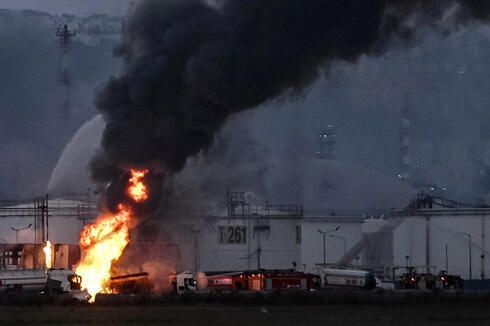
Iran missile strikes reshape Israel’s battle over the future of Haifa’s refineries
Bazan complex’s vulnerability has strengthened calls for evacuation, but concerns over energy independence are complicating the government’s plan.
Five years after an inter-ministerial committee recommended evacuating the Bazan oil refineries and petrochemical industries from Haifa Bay, the state is once again setting up a team to examine how to advance the controversial plan.
Calcalist has learned that, shortly before the political system enters an election period ahead of the October 27 vote, National Economic Council Chairman Prof. Avi Simhon is attempting to revive his flagship initiative to promote the evacuation of the refineries and transform Haifa Bay from an area dominated by heavy industry into a region focused on residential construction, green spaces, commercial development and cleaner industries.
The original government plan calls for Bazan’s evacuation by the end of 2029, but it is already clear that meeting this timetable will be extremely difficult. The National Economic Council previously commissioned a report from strategic consulting firm McKinsey ahead of the government’s 2022 decision, which recommended gradually shutting down petrochemical activity in Haifa Bay.
One of the reasons behind the establishment of the new team is the changing geopolitical and security environment in the Middle East, including the missile attacks on Israel’s critical infrastructure during recent conflicts with Iran.
In recent days, Simhon established a new inter-ministerial team under his leadership to examine the steps required to meet the timetable set in the government’s March 2022 decision. The team will examine how to overcome delays in building alternative storage facilities and address opposition to the plan, with the goal of returning the evacuation project to its original schedule.
The team is expected to present recommendations within six months. Its discussions will include representatives from the Haifa Bay Development Authority, the Ministries of Energy, Finance, Defense, Transportation and Environmental Protection, as well as the IDF, the Israel Land Authority and other planning bodies. The work will also be supported by an external consulting firm.
A source familiar with the team’s work told Calcalist that the move does not represent an attempt to reconsider the government’s 2022 decision.
“This is not a ‘pre-roll’ of the government decision from 2022, which remains in place, and there is no alternative to implementing it,” the source said.
However, the team will also examine concerns raised by the National Emergency Management Authority and the National Security Council regarding the impact of closing Bazan on Israel’s energy resilience. According to these bodies, in addition to establishing large-scale storage infrastructure for imported fuels, Israel must preserve domestic refining capabilities.
According to the source, maintaining both options simultaneously would be extremely costly.
“It is impossible to have both. Just building a new site for Bazan would take 10 to 15 years and cost at least NIS 10 billion,” the source said.
“The missile strikes changed the picture”
One of the central issues the new team will examine is the updated security assessment following the October 7 war and the subsequent conflicts with Iran.
A senior official in the Prime Minister’s Office told Calcalist that the original government decision was based on assessments made more than five years ago, before the security situation changed dramatically.
“The government’s decision was based on work done more than five years ago. Since then, a war broke out in which Bazan was hit several times by Iranian missiles, and changes occurred that led to an update of the national reference scenario,” the official said.
“The two campaigns against Iran demonstrated Bazan’s vulnerability and highlighted the urgency of closing it. As part of the team’s work, decisions will be made in accordance with the latest scenario,” the official added.
According to an implementation report presented earlier this year by the Haifa Bay Development Authority, 2026 represents a critical milestone in the evacuation plan. The program includes 99 separate “work packages,” but the report noted that about one-third require government funding, while only seven are currently ready to receive it.
A monitoring report published about four months ago by the Haifa Bay Development Authority found that the project was already facing delays of approximately one year, mainly due to delays in establishing facilities needed to store imported fuels and liquefied petroleum gas (LPG).
The delays involve the construction of a northern distillate storage and distribution facility, an LPG storage facility at the Yavor site, a dedicated maritime connection for unloading imported LPG, and a facility for exporting condensate.
While Simhon’s plan focuses on fully closing Bazan and transitioning Israel toward imported fuels, Energy Minister Eli Cohen has opposed the current approach and is promoting an alternative proposal to relocate Bazan’s operations to the Rotem Plain near Dimona.
The debate over Bazan’s future intensified following a report by State Comptroller Matanyahu Englman examining Israel’s preparedness in the energy and electricity sectors during emergencies.
The report stated that the October 7 war “reinforced Bazan’s importance to energy independence and the need to ensure a response to Israel’s energy needs.”
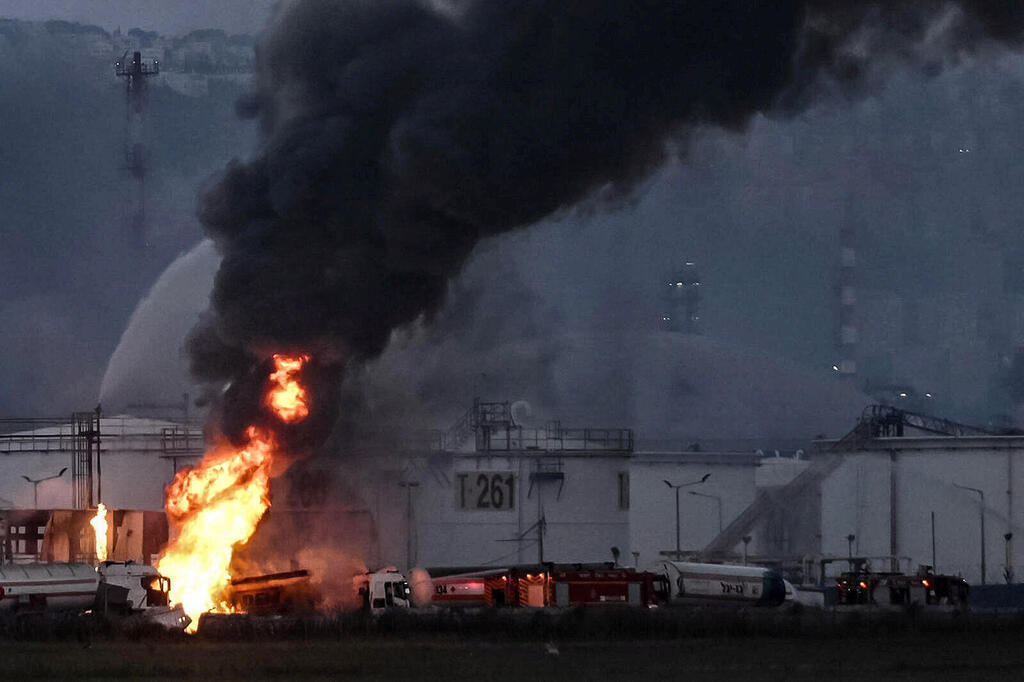
The comptroller’s review was conducted before Israel’s military campaigns against Iran in June 2025 and February 2026, during which Iran launched hundreds of ballistic missiles at Israel and struck strategic infrastructure, including the Bazan complex.
One Iranian missile strike in 2025 killed three Bazan employees and destroyed a power facility that produces steam and electricity for the group’s industrial operations in Haifa Bay. The attacks significantly disrupted Bazan’s operations for several months.
The comptroller also criticized the government for not sufficiently examining the impact of closing Bazan on energy infrastructure, particularly given plans to increase Israel’s reliance on imported LPG.
According to the report, 44% of LPG consumed in Israel is produced at Bazan, another 19% at the Ashdod Refinery, and the remainder is imported.
Bazan, which is controlled by Idan Ofer, has used the report to support its opposition to the evacuation plan. The company argued that the findings reinforce its warnings that the government’s 2022 decision was based on incorrect assumptions and did not adequately consider Israel’s energy needs during emergencies.
The company also argued that international restrictions and boycotts imposed on Israel following the war demonstrated the risks of relying heavily on imported fuels.



