











BiblioTech
CTech's Book Review: Innovation is no longer a corporate luxury
Ram Gev, Chief Financial Officer & Deputy CEO at Bank Hapoalim, shares insights after reading “Innovation or Elimination: Winning in a World of Constant Change” by Itai Green.
Ram Gev is the Chief Financial Officer and Deputy CEO at Bank Hapoalim. He has joined CTech to share a review of “Innovation or Elimination: Winning in a World of Constant Change” by Itai Green.
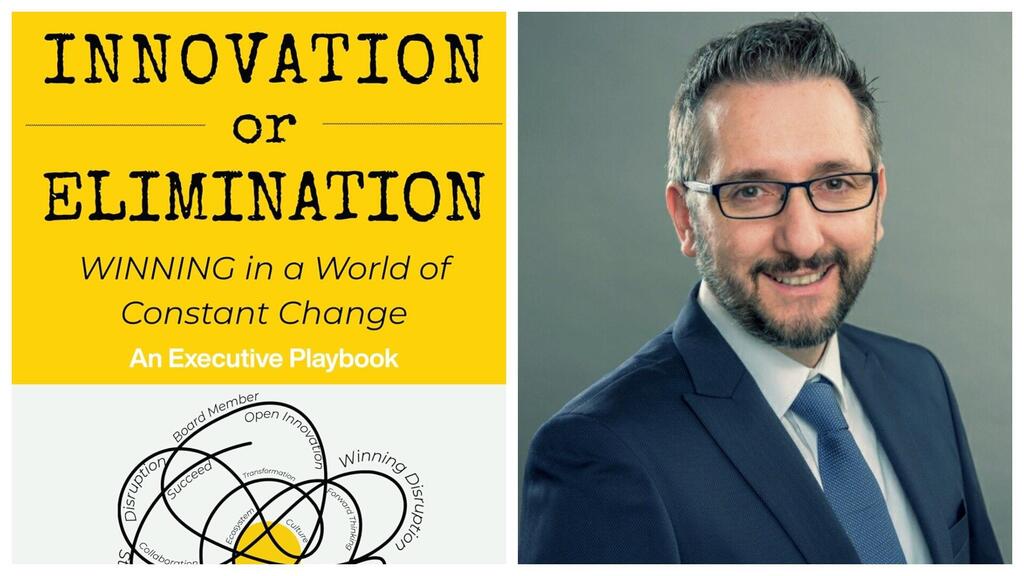
Title: Innovation or Elimination: Winning in a World of Constant Change
Author: Itai Green
Format: Book
Where: Home
Summary:
A few months ago, I had the privilege of receiving an early copy of Innovation or Elimination: Winning in a World of Constant Change by innovation consultant, speaker, and author Itai Green. A couple of months after its release, the book’s central thesis has acquired even greater relevance and meaning as organizations continue to confront rapid technological, economic, and geopolitical change.
In a world where market disruption has shifted from an occasional hurdle to a constant feature of the business environment, Green delivers an uncompromising message: innovation is no longer a corporate luxury, but a core business capability. The book serves as a practical roadmap for executives, boardrooms, and organizations seeking to navigate continuous, exponential change without losing their strategic direction or organizational stability.
While much business literature can leave readers with the impression that it relies heavily on broad concepts and fashionable buzzwords, the distinguishing strength of this book is its ability to combine strategic thinking with highly practical tools. Green draws on a rich background in corporate strategy and startup collaboration to outline how organizations can build structured pipelines for identifying, evaluating, and integrating external breakthroughs.
The book demystifies the mechanics of corporate-startup collaboration and provides frameworks that can be directly applied within complex, highly regulated enterprise environments.
Important Themes:
One of the most significant takeaways from Green’s work is his realistic view of execution velocity. As Green writes: “Time to market is everything. Even organizations with unlimited resources cannot buy time.”
From a corporate leadership perspective, this is a sobering reminder. Large, established enterprises can fall into the trap of assuming that their scale, market position, extensive resources, or strong customer base will protect them from disruption.
Green challenges this assumption, demonstrating that agility, streamlined decision-making, and open-innovation frameworks are essential for maintaining a competitive advantage as technology advances at an exponential pace.
Another central thesis of the book is that successful innovation depends heavily on internal cultural transformation. Green identifies executive resistance, misaligned incentives, and corporate ego as some of the most significant obstacles to meaningful progress.
Another important theme is the role of macroeconomic, technological, and geopolitical crises in accelerating transformation. Green makes a compelling argument that, while economic downturns and crises create immediate uncertainty, they can also reduce organizational hesitation, challenge established assumptions, and create valuable opportunities for innovation.
What I’ve Learned:
As a financial executive, I particularly connected with the book’s forward-looking perspective on modern financial institutions. Green argues that banks and similar organizations can no longer afford to view themselves solely as traditional financial institutions.
Instead, the future belongs to those that understand themselves as ecosystems combining advanced technology, sophisticated data analytics, agile services, trusted infrastructure, and a seamless customer experience.
This strategic and holistic shift is precisely what will increasingly distinguish the true leaders of the financial industry from the rest of the market.
At the same time, Green explains how organizations can conduct open-innovation activities efficiently and responsibly, positioning themselves not only for commercial success but also as credible, constructive, and attractive partners within the broader innovation ecosystem.
To achieve this collaborative success, one of the book’s key lessons is that corporate leaders must actively optimize their internal infrastructure and reduce unnecessary organizational friction.
This distinction is particularly important in financial institutions. Policies, controls, governance mechanisms, and structured processes are essential: they protect the organization, its customers, and the stability of the financial system. The challenge is therefore not to eliminate structure, but to distinguish between necessary controls and excessive bureaucracy that goes beyond what is required and unnecessarily slows execution.
Even the most resource-rich corporations cannot recover time lost when competing with agile startups. Green demonstrates that true efficiency requires optimizing internal procurement, legal, compliance, risk-management, and operational structures so that they can respond appropriately to the rapid pace of the external technology landscape.
For partnerships to thrive, large enterprises must also practice corporate humility. They must resist the urge to fully absorb external startups into rigid corporate hierarchies that may ultimately suppress the very flexibility, speed, and creativity that made those startups valuable in the first place.
Furthermore, Green provides highly practical insights into the use of proofs of concept and structured pilot programs as deliberate, controlled, and relatively low-risk forms of corporate due diligence.
A tightly scoped pilot can provide a transparent view of an external team’s technological capabilities, data integrity, adaptability, execution quality, and actual scalability. Rather than spending months in extended internal deliberations, sophisticated corporate innovators can use short-term collaborative achievements as objective stepping stones toward long-term commercial integration and, where appropriate, strategic investment.
Finally, the book teaches that building a successful open ecosystem requires looking well beyond a company’s immediate organizational boundaries.
Green explains that a healthy corporate innovation strategy demands active engagement with the different pillars of the innovation network, including academia, venture capital, technology hubs, startups, regulators, and industry peers.
He also highlights the proactive role that forward-thinking regulators can play in removing legacy barriers and enabling responsible digital transformation. Ultimately, mapping these local and cross-border networks and cultivating trust within the ecosystem are essential to transforming promising technological ideas into sustainable commercial value.
Critiques:
The strength of this book lies in its unvarnished realism and its high relevance to senior leadership. It encourages executives to conduct an honest assessment of their organization’s internal structures, decision-making processes, culture, and execution speed.
One possible critique is that the sheer volume of tactical methodologies, regulatory frameworks, and ecosystem models can be challenging for a busy executive to absorb in a single sitting.
For a playbook so deeply focused on maximizing efficiency, future editions could be enhanced by including additional executive summaries, implementation checklists, or quick-reference pages at the end of each major section.
There is also a broader implementation challenge that is especially relevant to large financial institutions. These organizations must constantly balance multiple legitimate considerations, including innovation, customer protection, regulatory compliance, operational resilience, risk management, financial discipline, and strategic prioritization.
These competing considerations can make a straightforward or overly literal application of innovation principles difficult. In practice, the ability to manage these tensions, and to determine where speed should be prioritized and where caution remains essential, is a critical capability in its own right.
A future edition could therefore explore in greater depth how large and highly regulated organizations can achieve this balance and translate the principles of open innovation into sustainable execution without undermining the controls and safeguards that remain fundamental to their role.
I would also personally have appreciated an audiobook version, allowing readers to engage with the book while travelling or on the go. I understand that an audiobook is expected to be released soon for those who prefer listening to reading.
Who Should Read This Book:
Innovation or Elimination is highly recommended reading for corporate executives, board members, and leaders of established organizations seeking to understand how technology, new competitors, and changing customer expectations are reshaping their industries.
It is particularly relevant for organizations already concerned about disruption. Perhaps, however, it is even more important for those that do not yet believe they have a reason to be concerned.
The book serves as a valuable guide for enterprise leaders who need to shift their corporate culture away from slow, inward-looking silos and toward more open, agile, and ecosystem-driven models of growth.
At the same time, startup founders and technology innovators seeking to partner with established institutions can gain valuable insights into the enterprise mindset, its legitimate constraints, and what is required to build meaningful, scalable, and lasting collaboration.



