










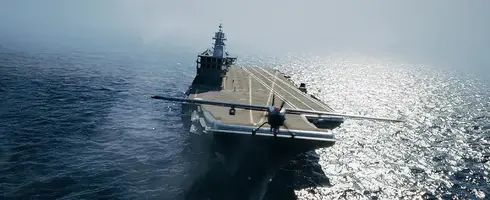
The rise of the drone ship: Elbit’s vision for extending naval power without aircraft carriers
The Israeli defense company is exploring a new maritime model built around commercial vessels carrying fleets of unmanned aircraft, offering countries a cheaper alternative to traditional carrier-based aviation.
For decades, extending military power across the oceans has required one of the most expensive assets in warfare: the aircraft carrier. But as maritime competition expands across vast areas, from island chains to trade routes and remote economic zones, a growing number of countries face the question of how can they see farther and respond faster without building a carrier fleet?
One answer being explored by Israel’s Elbit Systems is a commercial vessel converted into a floating base for unmanned aircraft.
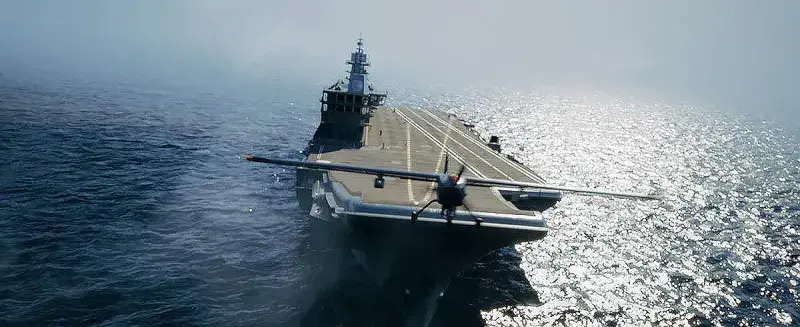
The company is developing the concept around the Hermes 650 Spark Maritime Apparatus, a system designed to allow a ship to carry multiple unmanned aircraft capable of flying long-duration missions far beyond the vessel’s own sensors.
Rather than recreating the capabilities of a US-style aircraft carrier, with its enormous cost and operational complexity, the concept is aimed at creating a smaller and more accessible form of maritime air power.
“The goal is not to imitate a U.S.-style aircraft carrier,” according to the concept presented by Elbit, but to create “a leaner and more accessible form of maritime airpower.”
The idea reflects a broader transformation taking place in military technology. As drones become increasingly capable, countries are looking for ways to replace some traditional manned platforms with cheaper, distributed systems that can operate over larger areas.
The most unusual part of Elbit’s concept is not necessarily the aircraft itself, but the platform from which it operates.
The company envisions converting standard commercial vessels into dedicated unmanned aviation platforms capable of carrying around nine to 12 Hermes 650 Spark aircraft, along with deck infrastructure, control systems, and mission-support equipment.
Such a ship would effectively become a floating remote aerial base, able to deploy drones that extend its surveillance and operational reach far beyond the range of onboard sensors.
The approach is designed for countries that face large maritime security challenges but do not have the resources, political need, or strategic ambition to operate traditional aircraft carriers.
A naval vessel can only see a limited distance. Helicopters can extend that range but require significant maintenance, crews, and operating costs. Smaller vertical takeoff and landing drones are easier to deploy, but generally provide less endurance and smaller payload capacity.
At the center of Elbit's system is the Hermes 650 Spark unmanned aircraft, which Elbit designed with several features intended to increase operational flexibility.
Unlike many unmanned aircraft that use rear-mounted engines, the Hermes 650 Spark uses a front-mounted engine configuration. According to Elbit, this provides greater power margins, enabling a wider speed range, heavier payloads, and short takeoff and landing (STOL) operations.
The aircraft is designed with two large payload bays, satellite communications capabilities, and advanced diagnostic systems.
Its STOL capability is particularly important for maritime operations because it allows the aircraft to operate from shorter runways and more limited aviation facilities.
The concept is not limited only to sea-based operations. Customers already operating the Hermes 900 could operate mixed fleets from the same ground-control infrastructure, allowing the Hermes 650 Spark to be integrated into existing command systems rather than requiring an entirely new operational framework.
In a maritime environment, the ship would serve as a launch and recovery platform, while mission control could remain distributed between land-based systems and onboard facilities.



